Kubernetes Networking
Networking is the foundation of distributed Kubernetes systems. Understanding how packets actually flow lets you debug effectively, design resilient architectures, and reason about performance.
This lesson covers pod-to-pod communication, services, ingress, CNI plugins, and network policies — the layers that make K8s networking work.

The Networking Model
Kubernetes networking has four core principles:
External access is opt-in: pods are private by default; you have to explicitly expose them via Services or Ingress.
The Network Layers
A typical K8s cluster has multiple overlapping networks:
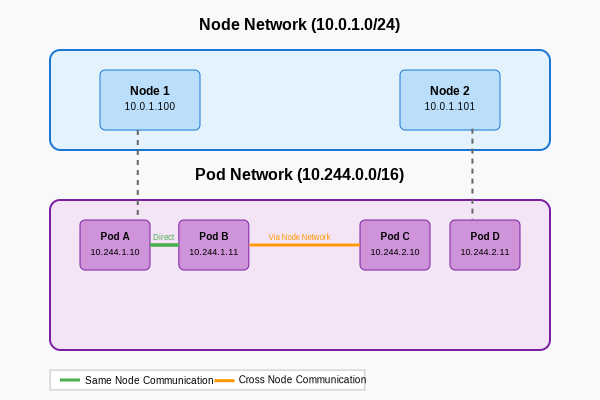
Direct pod-IP traffic (a headless Service, a StatefulSet peer, or a literal IP) never goes through a ClusterIP. The CNI bridge on the node is the switch:
- Same node. Pod A sends to Pod B’s IP. The packet hits the CNI bridge on that node and is delivered to Pod B. It does not leave the machine.
- Other node. Pod A sends to Pod C’s IP. The bridge hands the packet to the node network. The CNI either encapsulates it (VXLAN and similar overlays) or relies on cloud routes. The remote node’s bridge delivers it to Pod C.
kube-proxy is not on this path. It only matters once the destination is a Service IP.
CNI: The Plugin That Makes Pod Networking Work
Kubernetes itself doesn’t implement pod networking. It delegates to a CNI (Container Network Interface) plugin.
When a pod is created, the CNI plugin:
- Assigns an IP from the pod CIDR.
- Creates a virtual network interface in the pod’s network namespace.
- Sets up routing rules so other pods can reach this one.
- Applies network policies (if supported).
Major CNI plugins
Service Networking
Pods are ephemeral. Services provide stable virtual IPs that proxy to the current set of healthy backend pods.
How Services actually work
Pod → ClusterIP (10.96.42.7)
        │
        ▼  (kube-proxy iptables/IPVS rules)
        │
   ┌────┴────┬────────┬────────┐
   ▼         ▼        ▼        ▼
 Pod IP1   Pod IP2   Pod IP3   Pod IP4
 (the actual current backend pods)
kube-proxy watches Services and Endpoints, maintaining iptables (or IPVS) rules on every node. It programs the kernel. It does not sit in the packet path itself.
A packet to a ClusterIP then becomes ordinary pod traffic:
- Pod A sends to
backend-service’s ClusterIP. - The local iptables or IPVS rules rewrite the destination to a ready pod IP (random or round-robin).
- From there the packet follows the pod path above: CNI bridge, and the node network only if that pod is on another node.
A headless Service (clusterIP: None) skips the rewrite. DNS returns the pod IPs, and the client connects to one of them directly. That is how StatefulSet peers find each other.
Service types in detail
DNS
CoreDNS runs in every cluster, exposing service names as DNS records:
my-service.my-namespace.svc.cluster.local→ ClusterIPpod-ip.my-namespace.pod.cluster.local→ individual pod (rarely used directly)
Pods get the cluster DNS in their /etc/resolv.conf, so a simple curl http://my-service (within namespace) or curl http://my-service.my-namespace (cross-namespace) resolves correctly.
Ingress: HTTP/HTTPS Routing
Services give you Layer 4. Ingress gives you Layer 7.
                    [ Internet ]
                          │
                          ▼
                  [ Cloud Load Balancer ]
                          │
                          ▼
              [ Ingress Controller Pod ]
              (nginx, Traefik, ALB, etc.)
                          │
        ┌─────────────────┼─────────────────┐
        ▼                 ▼                 ▼
   [Service A]      [Service B]      [Service C]
   /api/*            /admin/*         /static/*
The Ingress resource is declarative routing config. The Ingress controller is the actual implementation — runs as pods, watches Ingress resources, configures itself accordingly.
Gateway API: The Ingress Successor
Gateway API is the modern replacement for Ingress. More expressive, role-oriented:
Gateway API will eventually replace Ingress in most clusters. New clusters should use it; existing should migrate.
Network Policies
By default, all pods can talk to all other pods. NetworkPolicies restrict this.
# Allow only pods labeled "app=frontend" to talk to "app=api"
apiVersion: networking.k8s.io/v1
kind: NetworkPolicy
metadata:
  name: api-from-frontend-only
spec:
  podSelector:
    matchLabels:
      app: api
  policyTypes:
  - Ingress
  ingress:
  - from:
    - podSelector:
        matchLabels:
app: frontendFor production, default-deny is the right baseline:
# Block all ingress to all pods unless explicitly allowed elsewhere
apiVersion: networking.k8s.io/v1
kind: NetworkPolicy
metadata:
  name: default-deny-ingress
spec:
  podSelector: {}
  policyTypes:
  - Ingress
Service Mesh: Layer 7 Networking as Infrastructure
Service meshes (Istio, Linkerd, Consul Connect) layer additional networking on top of the basic K8s networking:
We covered this in Service Meshes; in K8s context, it’s typically deployed as sidecar proxies (Envoy for Istio, linkerd2-proxy for Linkerd) injected into every pod.
Multi-Cluster Networking
For larger SaaS platforms running multiple K8s clusters:
Advanced
Four mechanisms that show up once a cluster is large. They are not another CNI, and they are not the Service types above.
Recap
- Kubernetes networking has four principles: unique pod IPs, direct pod-to-pod, node-to-pod, consistent IP visibility.
- Four overlapping networks: cluster, node, pod, service. Each managed differently.
- CNI plugins implement pod networking — pick consciously (Cilium, Calico, Flannel, cloud-native).
- Same-node pod traffic stays on the CNI bridge. Cross-node traffic crosses the node network, then the remote bridge. A Service packet is rewritten to a pod IP and then takes that same path.
- Services proxy stable virtual IPs to current backend pods via kube-proxy and iptables/IPVS. Headless Services skip the virtual IP.
- EndpointSlices, ExternalDNS, cert-manager, and dual-stack are the scale-out pieces: smaller endpoint objects, automatic DNS, automatic certificates, and two address families.
- Ingress provides L7 routing; Gateway API is the modern replacement.
- NetworkPolicies restrict pod-to-pod traffic; need a CNI that supports them.
- Service mesh layers L7 networking concerns (mTLS, traffic management, observability) as infrastructure.
- Multi-cluster networking enables federated platforms across regions and providers.